
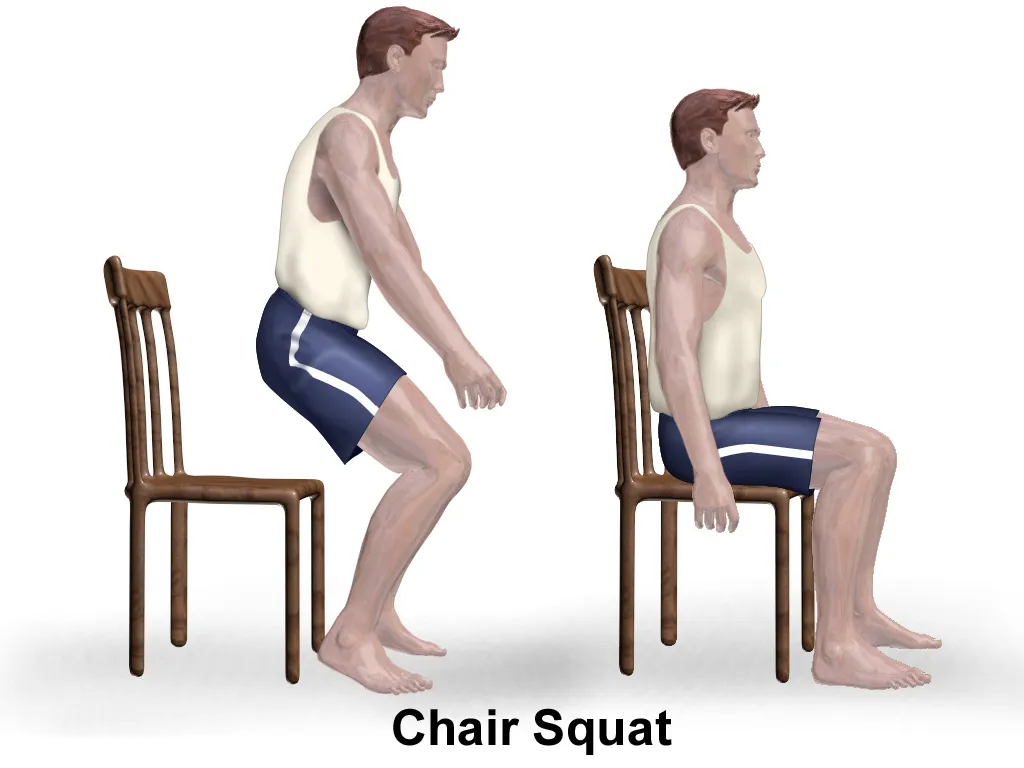
You can start building strength with a stable chair, a wall, and a small amount of regular time. Personal training can offer feedback, but it is not an admission requirement for exercise. Start with movements you can control rather than equipment you think you ought to own.
This is a gentle introductory example for adults who can perform these movements safely, not a rehabilitation program or a complete long-term strength plan. If you have symptoms, a recent operation, an injury, or uncertainty about suitability, ask an appropriate healthcare professional. Stop for sharp pain, dizziness, chest pain, or unusual breathlessness; severe symptoms require urgent help.
Choose equipment by need
- Chair and wall: the simplest starting option. Use a sturdy non-wheeled chair on a non-slip surface, secured against movement, and a solid wall.
- Resistance bands: inexpensive and portable, but inspect for damage and follow the exact band and anchor instructions. Do not improvise door anchors or pull toward your face.
- Dumbbells or a gym: useful for gradual loading and more exercise choices, but not necessary for this first routine. Ask for an equipment induction before using unfamiliar machines.
A free notebook works as well as a paid workout app for recording repetitions and how a session felt. You do not need to buy anything to try the chair-and-wall version.
A first session, step by step
Clear the floor, wear secure footwear, and move gently for a few minutes to warm up. Breathe normally during each movement rather than holding your breath. Rest between exercises until you feel ready; this is not a race.
1. Sit to stand
Sit near the front of a stable chair with feet flat and about hip-width apart. Lean forward slightly, stand slowly, then sit back down with control. Use the arms of the chair for assistance if needed; choose a seat height you can manage safely.
Try up to five controlled repetitions, fewer if needed. Avoid dropping into the chair or forcing yourself through joint pain. This follows the basic movement described in the NHS strength guide.
2. Wall press-up
Stand facing a solid wall at a comfortable distance, around arm’s length. Put your hands against it at chest height. Keeping your body controlled, bend your elbows to move toward the wall, then press back. Use a smaller range or stand closer if the movement is too hard.
Begin with up to five repetitions. Stop while you can still move smoothly. The NHS describes larger sets as a progression; you do not have to start there.
3. Supported calf raise
Hold the back of a secure chair or another stable support. With both feet on the floor, lift your heels as far as is comfortable, pause briefly, and lower slowly. Do not bounce or stand on an edge for this starting version.
Try up to five repetitions. Keep the support if it helps balance; removing it is not necessary to benefit from the movement.
One round is enough for an initial practice. These three movements are a starting sample, not full coverage of every major muscle group. Use the NHS’s illustrated guide for additional suitable movements as you gain confidence, including its biceps-curl example, or seek instruction for unfamiliar exercises.
Make progress without max testing
| Movement | Version or support used | Comfortable repetitions | Recovery notes |
|---|---|---|---|
| Sit to stand | Chair height / arm support | Your count | Comfort or symptoms |
| Wall press-up | Distance from wall | Your count | Comfort or symptoms |
| Calf raise | Stable support, floor level | Your count | Comfort or symptoms |
Choose two non-consecutive days that fit your week. Record the exercise version, repetitions, and comfort. When the same version feels controlled across several sessions, add a repetition or two before considering another round or more resistance. Change one thing at a time. If control deteriorates, reduce the difficulty or stop the set.
Some muscle soreness can follow unfamiliar exercise, but soreness is not the goal or proof that training worked. Reduce the next session if recovery is poor; persistent or concerning pain warrants assessment. You do not need a one-repetition maximum, failure sets, or a spotter-free heavy lift to establish a baseline.
Build toward a balanced routine
The CDC adult guidelines recommend muscle-strengthening activity on at least two days a week covering all major muscle groups. That is a direction to build toward, not a command to complete every exercise on day one. Over time, include appropriate leg, hip, back, abdominal, chest, shoulder, and arm work with technique you understand.
Sources: NHS illustrated strength exercises and CDC adult activity overview.