
Start with the time and energy you actually have. I’d rather start with an honest picture of your week than an ambitious schedule with nowhere to bend.
A calendar and a short weekly review are enough to begin. For longer-term goals and event priorities, use the annual training planner (PDF).
This is a planning framework, not a universal race program. A first exercise routine and a multi-day ultra need very different preparation. If an event’s demands are far beyond your current experience, reassess the timeline and seek qualified advice where needed rather than compressing a generic plan.
Choose a free planning tool
- Paper or the free printable weekly planner (PDF): simple, private, and no account required.
- Calendar or spreadsheet: useful for moving sessions and comparing planned versus completed work. Start with date, activity, duration, effort, and a short note.
- Free structured plan: useful if its starting requirements, goal, schedule, and progression fit you. Do not choose solely by its promised finish time. Check who wrote it and whether it explains modifications and recovery.
- Watch or training app: optional convenience. Automatic readiness scores and generated plans are estimates, not orders or medical clearance. Review permissions before uploading health-related information.
Step 1: define an achievable next goal
Write one specific goal tied to your current situation: “Walk comfortably for 30 minutes,” “Return to two regular rides each week,” or “Finish my first local event with consistent preparation.” Add a review date, not just a race date.
Then write what you can already do comfortably and consistently. Use recent ordinary weeks, not your best week years ago. If you are returning after illness, injury, or a long break, start from current capacity and seek relevant guidance.
Step 2: budget time before workouts
Mark work, caring responsibilities, travel, pool access, and likely sleep opportunities. Include setup and travel time in an exercise slot. Reserve recovery time rather than filling every gap.
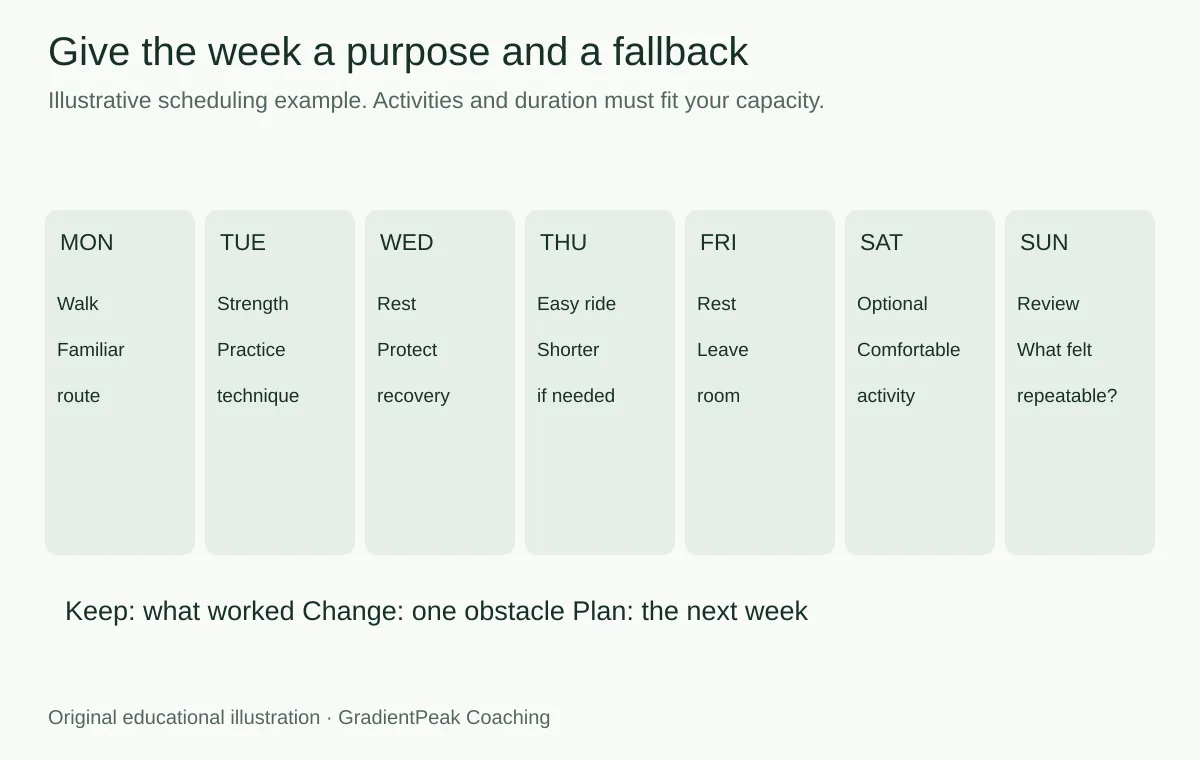
Choose a minimum week you can repeat. For someone already comfortable with these activities, an illustrative week might include a short walk on Monday, strength practice Tuesday, rest Wednesday, an easy ride Thursday, rest Friday, an optional comfortable activity Saturday, and a review Sunday. Distances and durations should fit that person’s current capacity. This is a scheduling example, not a complete health guideline or race-preparation plan.
Step 3: give every session a purpose and a fallback
Write the purpose in ordinary language: easy aerobic movement, strength practice, technique, or recovery. If you cannot explain why a demanding session belongs in the week, you may not need it yet.
For each planned session, choose a smaller version: a shorter familiar route, gentle walking instead of a run, or rest when ill or excessively tired. Do not cram missed sessions into the next day. In multisport, count the combined load across swimming, cycling, running, and strength.
| Planned activity | Likely obstacle | Reasonable fallback |
|---|---|---|
| Walk after work | Meeting finishes late | Shorter familiar route |
| Usual session | Illness or unusual exhaustion | Rest and reassess |
| Pool session | Pool closes unexpectedly | Replan rather than squeeze it into another day |
Planning a triathlon week
Put pool opening times and other fixed-access sessions on the calendar first. Allow for travel, changing, bike setup, and meals, not just workout duration. A free hour is not necessarily an hour in the pool.
Consider the combined demands of swim, bike, run, and strength alongside work, family, and sleep. Identify each session’s purpose before deciding what to shorten or move. If you have a coach, agree which priorities to protect when the week changes rather than stacking missed sessions together.
When the week changes
Suppose an established triathlete loses two training days to work travel. I wouldn’t start by moving every missed workout into the weekend. I’d first look at the week’s purpose, recent training, and recovery.
- Pool session no longer fits: check the next realistic pool window. Don’t automatically add a hard run in its place; it has a different purpose and cost.
- Travel cuts into sleep: reconsider the demanding session rather than treating the original calendar as a requirement.
- The weekend is still available: keep the most useful work that recovery allows. Drop lower-priority work instead of compressing the whole week.
The next review is about what felt manageable and how you recovered, not whether every box was checked.
Step 4: track effort without buying sensors
| Planned purpose | What I did | How it felt | Next change |
|---|---|---|---|
| Easy movement, skill, strength, or recovery | Activity and duration | Effort, comfort, symptoms | Keep, simplify, or reconsider |
Use the CDC talk test: moderate activity generally allows talking but not singing; vigorous activity limits you to a few words before pausing for breath. For easy sessions, keep conversation comfortable. This is a relative effort guide, not a measured lactate threshold.
Afterward, record what you actually did, how it felt, and whether anything hurt. A watch can add duration or heart rate, but the notes work without it. Do not push to match an app target when conditions, symptoms, or fatigue say otherwise.
If you use a heart-rate sensor, follow its fitting instructions and compare familiar activities under similar conditions. Record heat, fatigue, and medication changes that may affect the reading. Heart rate and the talk test describe effort; neither measures blood lactate or establishes a precise threshold. Medication can also make generic heart-rate targets unsuitable.
Step 5: review and progress deliberately
At the end of the week ask: What was repeatable? What left me unusually tired? What got in the way? What should stay the same?
Repeat a manageable week before adding more. When ready, make one small change, such as a little more time in one easy session, rather than increasing duration, frequency, and intensity together. There is no universal “10% rule” that guarantees safe progression. Reduce load when recovery or life demands call for it, and stop for concerning symptoms.
Use guidelines as a direction, not a starting quota
The CDC adult activity overview recommends at least 150 minutes of moderate aerobic activity, or 75 minutes vigorous or an equivalent mix, plus muscle strengthening on two days each week. Some activity is better than none, and these population guidelines are not an individualized starting dose or an ultra-endurance training prescription. CDC examples show ways to spread activity through the week.
Long events also require appropriate skill, terrain, fueling, equipment, and safety preparation. Do not extrapolate a beginner schedule into an ultra plan simply by adding more hours.
Plan the next week
Write a realistic week and schedule a ten-minute review. Seek a clinician for health concerns and qualified instruction for activities you cannot yet do safely.